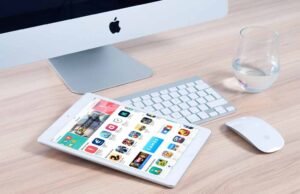


Apple’s October 2026 product announcements mark a significant moment in personal computing, bringing touchscreen interaction to the MacBook Pro, next-generation Apple silicon, advanced OLED displays, and deeper artificial intelligence integration across its ecosystem.
By Arvind Gupta | Technology, AI & Innovation
Published: 31 October 2026 | Last updated: 31 October 2026
Apple has spent decades refining the relationship between hardware, software, and human interaction. Its latest October 2026 announcements suggest that the company is preparing for another major transition: the integration of more powerful AI capabilities into everyday computing, alongside new ways of interacting with professional devices.
Among the most notable announcements is the new MacBook Pro with PROLED XDR Display, which introduces touchscreen functionality to the Mac for the first time. Apple has also announced an M6-powered 14-inch MacBook Pro, a redesigned iMac powered by M6, a substantially updated iPad mini featuring OLED technology, and new AI-assisted creative tools.
These announcements are important for more than their specifications. They illustrate how Apple is positioning its products for software developers, designers, filmmakers, students, business owners, researchers, and an increasingly AI-driven global economy.
For consumers in India, the United States, Europe, and other markets, the central questions are practical: What has changed? Which products offer meaningful improvements? How useful are the new AI capabilities? And should existing users consider upgrading?
This comprehensive guide examines the announced products, their technical capabilities, their potential impact, and what buyers should consider before making a purchasing decision.
1. Apple’s October 2026 Launches at a Glance
Apple’s recent announcements cover several parts of its computing and creative ecosystem.
| Product or announcement | Major development | Who may benefit most |
|---|---|---|
| MacBook Pro with PROLED XDR | Tandem OLED display and touchscreen interaction | Filmmakers, designers, photographers and professional creators |
| 14-inch MacBook Pro with M6 | New Apple silicon and enhanced on-device AI performance | Developers, engineers, students and business professionals |
| iMac with M6 | Updated all-in-one desktop with improved AI and graphics performance | Families, offices, creators and small businesses |
| iPad mini | 8.5-inch OLED display, A20 Pro chip and IP67 protection | Mobile professionals, students, field workers and digital readers |
| Apple Creator Studio | Expanded AI-assisted creative tools and professional workflows | Video editors, musicians, designers and content creators |
| macOS 27 and related software | Siri AI and deeper system-level intelligence | Users across Apple’s Mac ecosystem |
The touchscreen MacBook Pro is arguably the most consequential hardware announcement because it changes a long-standing aspect of the Mac experience. Meanwhile, the M6 products and software updates demonstrate Apple’s broader emphasis on performance, energy efficiency, and AI processing.
The products are not identical in purpose, and buyers should evaluate them according to their workloads rather than treating the entire launch as a single upgrade.
Official announcements: Apple Newsroom — https://www.apple.com/newsroom/archive/?month=10&year=2026
2. MacBook Pro with PROLED XDR: Touch Comes to the Mac
Apple’s new MacBook Pro with PROLED XDR Display is the standout announcement of October 2026.
The laptop is available in 14-inch and 16-inch configurations and combines a tandem OLED display, touchscreen interaction, M5 Pro and M5 Max processors, and deeper integration with Apple’s AI-powered software.
For years, Apple’s MacBook line has relied primarily on the keyboard, trackpad, and external pointing devices. The introduction of touch creates another way to interact with applications while retaining those familiar controls.
This is not simply a display upgrade. It represents a change in how professionals can manipulate digital content.
What makes PROLED XDR different?
According to Apple’s announcement, the display features:
- Tandem OLED technology.
- Up to 2,000 nits of peak HDR and SDR brightness.
- A claimed 10,000,000:1 contrast ratio.
- Adaptive refresh rates of up to 120Hz.
- Support for the P3 and Adobe RGB colour spaces.
- More than 80% Rec. 2020 colour coverage for HDR video workflows.
- An optional nano-texture finish to reduce glare.
OLED technology allows individual pixels to control their own light output. This enables exceptionally deep blacks and high contrast, making it valuable for viewing HDR footage, editing photographs, and working with detailed visual content.
Tandem OLED uses two light-emitting layers. Apple says its implementation is designed to improve brightness uniformity, manage reflections, and maintain image consistency.
The benefits are especially relevant to professionals who need to evaluate colour and image detail accurately.
However, a technically impressive display does not automatically guarantee better results. Professional colour work still depends on calibration, application support, viewing conditions, and the accuracy of the entire production workflow.
Why touchscreen functionality matters
The touchscreen is designed to complement, rather than eliminate, traditional MacBook controls.
Users can scroll through webpages, zoom into images, reposition presentation elements, and interact directly with supported creative applications.
For example:
Video editing: Editors can select portions of a timeline, move clips, and zoom into edits using touch.
Graphic design: Designers can interact directly with visual elements and use supported tools in applications such as Pixelmator Pro.
Music production: Musicians can interact with onscreen instruments, keys, chords, and drum pads in Logic Pro.
Software development: Developers can explore touch-based interaction and test how supported iOS and iPadOS applications respond to touch input.
These workflows could be particularly useful when visual interaction is more natural than moving a pointer across the screen.
Nevertheless, developers should not assume that every existing Mac application will automatically become touch-optimised. The quality of the experience will depend on software design, interface controls, and application updates.
Performance, memory and storage
The new touchscreen MacBook Pro uses Apple’s M5 Pro and M5 Max chips.
Apple lists configurations with up to 128GB of unified memory and up to 16TB of storage. Battery life is rated at up to 24 hours, although actual results depend on configuration, workload, brightness, and other usage conditions.
Connectivity includes Thunderbolt 5, HDMI, an SDXC card slot, MagSafe, Wi-Fi 7, and Bluetooth 6.
These specifications position the machine for demanding professional workloads, including high-resolution video production, 3D modelling, software development, and large creative projects.
The most interesting aspect is the combination of display technology, touch interaction, processing power, and application integration. The value of the product will ultimately depend on how effectively these capabilities work together in everyday professional use.
Official reference: Apple’s MacBook Pro with PROLED XDR announcement.
3. Apple M6: A New Direction for Performance and On-Device AI
Apple’s October announcements also include the new 14-inch MacBook Pro with M6 and the iMac with M6.
These devices demonstrate the company’s continued investment in custom silicon, where the processor, graphics hardware, memory architecture, and AI acceleration are designed to work together.
What is Apple silicon?
Apple silicon refers to Apple’s custom-designed processors used in products such as the Mac, iPad, and iPhone.
Modern Apple chips combine several processing components, including:
- A CPU for general-purpose computing.
- A GPU for graphics and parallel workloads.
- Neural processing hardware for machine-learning tasks.
- Memory systems designed to move data efficiently between processing components.
This integrated approach can improve performance per watt and reduce the need to move data between separate components.
For laptop users, efficiency matters because demanding workloads must be completed without excessive heat, fan noise, or battery consumption.
For AI workloads, specialised acceleration can help supported applications process images, analyse data, and run certain machine-learning models more efficiently.
The 14-inch MacBook Pro with M6
Apple’s new 14-inch MacBook Pro features a 12-core CPU, a 12-core GPU, and a dual 16-core Neural Engine.
According to Apple’s published comparisons, the M6 delivers up to 30% faster graphics performance and up to 25% faster on-device AI performance than M5 in the stated tests.
The company also reports substantially larger gains for certain workloads when compared with the 13-inch MacBook Pro with M1.
These are manufacturer-reported results, not universal performance guarantees. Actual improvements depend on the application, configuration, software version, and type of work being performed.
For developers, faster compilation and local AI processing may be more valuable than improvements in everyday browsing or office applications.
For creators, graphics acceleration can help with image editing, rendering, effects, and other demanding tasks.
The machine also offers Wi-Fi 7, Bluetooth 6, a Liquid Retina XDR display, and battery life rated at up to 24 hours.
The M6-powered iMac
Apple’s updated iMac combines the M6 processor with a 24-inch 4.5K Retina display and an all-in-one desktop design.
It is available in seven colours: blue, green, pink, yellow, purple, orange, and silver.
Apple highlights improvements in graphics, AI performance, connectivity, and storage. The updated model also supports Wi-Fi 7, Bluetooth 6, and configurations with up to four Thunderbolt 4 ports.
The iMac is particularly relevant to people who want a clean desktop setup without purchasing a separate monitor.
It could serve as a workstation for office productivity, education, content creation, web development, and small-business administration.
However, the all-in-one design comes with a trade-off: users should consider their future upgrade requirements, display preferences, and the cost of the complete configuration before buying.
Why M6 matters beyond benchmark scores
The long-term importance of Apple silicon is not just about making computers faster.
As AI tools become integrated into operating systems and professional applications, computers increasingly need to perform a combination of traditional computing and machine-learning workloads.
A processor that can efficiently handle both can improve responsiveness while reducing dependence on remote processing for supported tasks.
That does not mean every AI model can run locally, or that local processing will always be faster. Model size, memory capacity, software optimisation, and computational requirements still matter.
The direction is nevertheless clear: AI capability is becoming an increasingly important part of how computer hardware is designed and marketed.
Official references:
4. The New iPad Mini: OLED in a More Portable Form
Apple has also announced a substantially updated iPad mini.
The new model combines an 8.5-inch OLED display with the A20 Pro chip, a thinner 5.4mm design, faster connectivity, and IP67-rated resistance to water and dust.
It is designed for people who want the flexibility of a tablet without carrying a full-sized device.
An OLED display in a compact tablet
The new Super Retina XDR display offers pixel-level light control, deep blacks, and support for the P3 wide colour gamut.
Apple specifies peak brightness of up to 1,200 nits, a 2,000,000:1 contrast ratio, and a minimum brightness of one nit.
A nano-texture display option is also available.
These features could make the tablet useful for reading, viewing photographs, reviewing documents, and working in different lighting conditions.
The larger display also gives users additional room to interact with applications while retaining a compact form factor.
A20 Pro and AI performance
Apple says the A20 Pro brings a significant performance improvement, with Neural Accelerators in each GPU core and a dual 16-core Neural Engine.
The company reports up to 4.5 times faster AI performance than the previous generation for its specified tests.
The practical benefits will depend on the applications being used.
Potential use cases include AI-assisted image editing, supported on-device models, document processing, and creative applications.
Who should consider the new iPad mini?
The compact form factor could suit:
- Students who need a portable reading and note-taking device.
- Doctors and healthcare professionals reviewing information in appropriate applications.
- Field engineers who need access to digital documents.
- Travellers who want a small device for entertainment and productivity.
- Creators who work with supported drawing and image-editing tools.
- Professionals who frequently move between meetings or work locations.
The iPad mini is not necessarily a replacement for a laptop. Users who need extensive multitasking, a full desktop development environment, or specialised professional software should compare their workflow requirements carefully.
Official reference: Apple’s new iPad mini announcement.
5. Apple Intelligence and Siri AI: From Features to Workflows
Hardware is only one part of Apple’s latest announcements. The software direction is equally important.
Apple’s new MacBook Pro and M6-powered devices are designed to work with macOS 27, while the updated iPad mini uses iPadOS 27.
Apple describes a more capable version of Siri, referred to as Siri AI, alongside expanded Apple Intelligence functionality.
The broader ambition is to make AI available within the applications and workflows people already use.
What could the new AI experience enable?
Apple describes capabilities involving personal context, system-wide search, document assistance, and actions across applications.
Examples of potential productivity benefits include:
Finding information: Users may be able to locate relevant content across supported messages, emails, photographs, and documents more efficiently.
Understanding content: Visual Intelligence can help users seek information about content displayed on their screens.
Writing assistance: AI features can assist with drafting, editing, and improving written material in supported applications.
Creative work: Supported tools can help generate or modify images and accelerate certain editing tasks.
Workflow automation: Natural-language descriptions can help users create certain automations through Shortcuts.
System-level assistance: Siri AI is intended to become more integrated with system search and supported applications.
The value of these features will depend on how reliably they understand requests, how well they handle context, and whether they can complete tasks without creating additional work for the user.
The importance of on-device AI
One of Apple’s key hardware advantages is its ability to integrate AI acceleration into its custom processors.
On-device processing can offer several benefits:
- Privacy: Certain information can be processed locally rather than sent to a remote service.
- Responsiveness: Local processing can reduce network delays for supported workloads.
- Offline capability: Some features may continue to work without an internet connection.
- Cost efficiency: Local inference can reduce dependence on paid cloud inference for compatible tasks.
- Integration: AI features can be built directly into operating-system functions and applications.
However, on-device AI is not automatically private in every situation. Some features may rely on remote models or cloud infrastructure.
Users should understand which features process data locally, which require a connection, and what information is shared with external services.
Availability also matters. Apple states that some Apple Intelligence features depend on supported languages, regions, devices, and software versions. The announced Siri AI capabilities have specific language and availability requirements.
Important for Indian users: Before purchasing a device specifically for AI, verify that the individual features you need are available in India and support your preferred language. Do not assume that every advertised capability will work identically in every country.
6. Apple Creator Studio: AI Enters the Professional Creative Workflow
Apple has announced additional features for Apple Creator Studio, its collection of creative applications.
The updates cover video editing, image manipulation, music production, and productivity applications.
The announcement is particularly relevant to independent creators and small businesses that want to produce professional content without assembling a large collection of separate tools.
Final Cut Pro
Apple says Final Cut Pro is gaining integrated MotionVFX content, additional visual effects, templates, transitions, motion graphics, and access to curated content through the Content Hub.
The updated workflow also allows supported image-editing tasks to move between Final Cut Pro and Pixelmator Pro.
These changes could reduce friction when editors need to combine video footage, graphics, titles, and visual effects.
Pixelmator Pro
Pixelmator Pro is introducing Generate Fill, which allows users to select an area of an image and describe the desired modification.
This approach can make certain editing tasks more accessible, particularly when a creator needs to modify part of an image without manually constructing every element.
As with other generative tools, users should review the resulting images carefully for visual inconsistencies and accuracy.
Logic Pro
Logic Pro is gaining an intelligent assistant in beta, an enhanced Stem Splitter that can separate drums, and a redesigned sound browser.
These features are intended to help musicians explore sounds and work with audio more efficiently.
They do not eliminate the need for musical judgement, recording quality, arrangement skills, or mixing expertise.
Keynote, Pages and Numbers
Apple also describes new AI-assisted features for its productivity applications, including assistants that understand document context and support for the Model Context Protocol (MCP).
MCP is a standardised approach for connecting AI applications with external tools and information sources.
Its potential significance is that AI systems can become more useful when they can interact with appropriate tools rather than merely generate text.
For businesses, this could eventually support more integrated document, data, and workflow automation. The real value will depend on implementation quality, permissions, reliability, and the safeguards around sensitive information.
Apple says the Creator Studio updates will be available as free updates for existing subscribers in November 2026.
Official reference: Apple Creator Studio’s October 2026 updates.
7. Apple’s October 2026 Pricing and Availability
Pricing is an important consideration because the new devices target different audiences and budgets.
The following information reflects the announced pricing available from Apple’s published launch materials. Prices in different countries should not be treated as directly interchangeable because taxes, configurations, local pricing, and availability can vary.
MacBook Pro with PROLED XDR
Apple’s announced US starting prices are:
| Model | US starting price |
|---|---|
| 14-inch MacBook Pro with M5 Pro and PROLED XDR | $2,899 |
| 16-inch MacBook Pro with M5 Pro and PROLED XDR | $3,399 |
| 14-inch MacBook Pro with M5 Max and PROLED XDR | $4,499 |
| 16-inch MacBook Pro with M5 Max and PROLED XDR | $4,799 |
Apple announced pre-orders beginning on 28 October 2026, with availability starting on 6 November 2026 in the markets covered by its announcement.
These are US starting prices, not confirmed Indian retail prices. Buyers in India should check Apple’s India store for local pricing and availability before making a purchase.
14-inch MacBook Pro with M6
Apple lists a US starting price of $1,999 for the new 14-inch MacBook Pro with M6.
This model is distinct from the higher-priced MacBook Pro with PROLED XDR and M5 Pro or M5 Max.
That distinction matters: buyers should compare the specific chip, display, memory, storage, and intended workload rather than assuming every new MacBook Pro offers the same configuration.
iMac with M6: India pricing
Apple’s published India announcement lists the following starting prices:
| iMac configuration | Starting price in India |
|---|---|
| M6 with 10-core CPU and 10-core GPU | ₹1,74,900 |
| M6 with 12-core CPU and 12-core GPU | ₹1,99,900 |
Apple also lists education pricing of ₹1,68,900 and ₹1,87,900, respectively, for the configurations described in its announcement.
The final price can increase with additional memory, storage, accessories, and other configuration choices.
iPad mini
The iPad mini announcement describes the new hardware and its availability schedule. Indian buyers should verify the final India-specific price and configuration directly with Apple rather than relying on converted US prices or unofficial estimates.
Where should you check before buying?
Use Apple’s official regional stores and product pages to confirm the final price, delivery date, available configurations, warranty terms, and trade-in options.
Prices and availability can change. Always verify the information at the time of purchase.
8. What Do the New Apple Products Mean for India?
India is an important market to consider when evaluating Apple’s latest product strategy.
The country has a growing technology workforce, a large student population, a substantial base of independent digital creators, and businesses that increasingly depend on software and digital services.
However, the usefulness of a new device depends on the work it enables, not simply on its launch specifications.
For software developers and engineers
The M6 MacBook Pro may be attractive to developers who need a portable machine for code compilation, local testing, virtualisation where supported, and AI-assisted development.
For .NET developers, it is important to check compatibility before switching from Windows.
Although development environments and tools such as Visual Studio Code, Git, Docker, and many programming languages are available on macOS, specific enterprise applications, Windows-only utilities, and some deployment workflows may require alternatives.
Developers who depend on Microsoft SQL Server administration tools, Windows-specific development environments, or particular enterprise systems should evaluate their exact requirements.
A powerful Mac does not automatically replace every Windows workstation.
For AI engineers
The growing emphasis on local AI processing is relevant to developers experimenting with language models, image generation, and AI-enabled applications.
Unified memory can be useful when running supported local models because model size and memory requirements often determine which workloads a machine can handle.
Nevertheless, buyers should not assume that an advertised AI performance increase translates into the same improvement for every large language model.
The practical results depend on model architecture, quantisation, context length, software optimisation, and memory availability.
Developers building production AI services will also need to consider cloud infrastructure, data governance, security, monitoring, and operational costs.
For Indian content creators
The touchscreen MacBook Pro and Creator Studio updates could be useful for video editors, filmmakers, photographers, musicians, and digital agencies.
A better display and more direct editing controls can help improve the production experience.
Yet a professional workflow also requires suitable storage, backup systems, reliable internet access when cloud services are involved, and software that matches the client’s delivery requirements.
For freelancers, the right investment is the machine that improves productivity enough to justify its total cost.
For students
The new iPad mini offers portability, while the M6 MacBook Pro provides a more traditional computing environment.
Students should choose according to their course requirements.
A tablet may be sufficient for reading, handwritten notes, online learning, and document review. Software engineering, 3D design, scientific computing, and some professional courses may require a laptop with specific applications and development tools.
For many students, an older MacBook, a capable Windows laptop, or a lower-cost tablet may offer better value than purchasing a premium device immediately.
For Indian businesses
Small businesses should look beyond hardware performance.
The real return on a computer investment comes from improvements in employee productivity, reduced processing time, lower operational friction, and the ability to deliver work more efficiently.
Before purchasing new devices, businesses should evaluate:
- Software and application compatibility.
- Security and device-management requirements.
- Data protection and regulatory obligations.
- Repair and service options.
- Total cost of ownership.
- The expected useful life of the device.
- Whether the new hardware solves an existing business problem.
The best purchasing decision is the one that supports measurable business outcomes.
9. How Apple’s Strategy Compares with the Wider AI Industry
Apple is not the only company investing in AI-capable personal computers.
Microsoft, Qualcomm, Intel, AMD, NVIDIA, and other technology companies are developing hardware and software for AI-assisted computing.
At the same time, companies such as Google, Microsoft, OpenAI, and others are developing AI systems that operate across applications, browsers, cloud services, and developer tools.
The industry is moving towards a combination of local and cloud-based AI.
Local AI versus cloud AI
| Consideration | On-device AI | Cloud-based AI |
|---|---|---|
| Internet requirement | May work offline, depending on the feature | Usually requires a connection |
| Data handling | Some processing can remain on the device | Data may be sent to remote services |
| Processing capacity | Limited by local hardware and memory | Can use large remote computing resources |
| Response time | Can be fast for supported workloads | Depends on network conditions and service performance |
| Operating cost | Hardware and electricity are primary costs, although software fees may apply | May involve subscription, usage, or API charges |
| Model choice | Limited to compatible local models and applications | Can provide access to a broader range of hosted models |
Neither approach is universally superior.
Local AI can be attractive for privacy-sensitive work and tasks that benefit from immediate responses. Cloud AI can be more suitable for workloads that need large models or substantial computational resources.
A well-designed AI system may use both approaches, selecting the most appropriate option for each task.
Apple’s differentiation
Apple’s strategy combines custom silicon, operating-system integration, hardware design, application distribution, and a connected device ecosystem.
This integration can simplify the user experience when the components work well together.
However, businesses also need flexibility, interoperability, transparent data policies, and the ability to work with their existing systems.
For developers and organisations, the important question is not whether one company’s ecosystem is universally better. It is whether that ecosystem supports the required applications, security standards, workflows, and long-term business objectives.
10. Should You Upgrade to Apple’s Latest Devices?
The answer depends on what you currently own and how you use it.
Consider the touchscreen MacBook Pro if:
- You regularly edit high-resolution video or colour-critical imagery.
- You can make practical use of touch controls in supported creative applications.
- Your workloads benefit from M5 Pro or M5 Max performance.
- You need substantial memory or storage for professional projects.
- Your current laptop is limiting your productivity.
Consider the M6 MacBook Pro if:
- You need a portable development or creative workstation.
- You run demanding applications that benefit from the new processor.
- You want improved local AI performance.
- You are upgrading from an older Intel-based Mac or an early Apple silicon model.
- Battery life and performance are important to your working day.
Consider the M6 iMac if:
- You prefer an all-in-one desktop.
- You want a large, high-resolution display integrated into the computer.
- You work primarily at a fixed desk.
- Your applications are compatible with macOS.
- The device’s performance and price suit your business or household requirements.
Consider the new iPad mini if:
- Portability is your main priority.
- You read, annotate, or review documents frequently.
- You need a compact device for travel or fieldwork.
- Your essential applications are available on iPadOS.
- A tablet suits your workflow better than a traditional laptop.
Who should wait?
You may not need to upgrade if your existing computer already handles your work efficiently.
For everyday browsing, video calls, office applications, and light productivity, an older machine may remain perfectly adequate.
Premium hardware makes sense when it solves a genuine problem, supports new work, or saves enough time to justify the expense.
11. What Apple’s Latest Launch Means for the Future of Computing
Three developments stand out from Apple’s October announcements.
First: AI is becoming a standard computing capability
AI is moving beyond separate websites and applications.
It is increasingly integrated into operating systems, productivity tools, creative software, search, and automation.
This could change how people interact with computers, but the benefits will depend on reliability, ease of use, privacy, and application support.
Second: Hardware and software are becoming more closely connected
Custom processors, dedicated AI acceleration, advanced displays, and operating-system features are being developed as parts of a larger system.
This approach can produce meaningful improvements when hardware capabilities are supported by well-designed software.
It also makes compatibility and ecosystem choices increasingly important for consumers and businesses.
Third: Professional computing is becoming more flexible
Touchscreen interaction, powerful portable processors, and AI-assisted creative applications offer new ways to complete professional tasks.
The long-term impact will not be determined by specifications alone. It will depend on whether these capabilities improve real workflows and enable people to create better work in less time.
For India, the opportunity is particularly relevant to software developers, design agencies, independent creators, entrepreneurs, and technology-led businesses.
But affordability, software compatibility, language support, and access to technical skills will remain important factors in determining how widely these technologies are adopted.
12. Frequently Asked Questions About Apple’s October 2026 Launches
What is Apple’s most significant new product announcement in October 2026?
One of the most significant announcements is the MacBook Pro with PROLED XDR Display, which introduces touchscreen functionality to the Mac alongside tandem OLED technology and M5 Pro and M5 Max processors.
Has Apple launched a touchscreen MacBook Pro?
Yes. Apple announced the touchscreen MacBook Pro with PROLED XDR Display on 28 October 2026. The company says touch is designed to work alongside the keyboard and trackpad.
What is the difference between the M6 MacBook Pro and the touchscreen MacBook Pro?
The newly announced 14-inch M6 MacBook Pro is a separate model focused on performance, connectivity, and on-device AI. The touchscreen MacBook Pro with PROLED XDR uses M5 Pro or M5 Max processors and adds the new tandem OLED display and touch interaction.
What is special about Apple’s PROLED XDR display?
Apple describes it as a tandem OLED display with up to 2,000 nits of peak HDR and SDR brightness, a 10,000,000:1 contrast ratio, refresh rates up to 120Hz, and support for P3 and Adobe RGB colour spaces.
What is the price of the new MacBook Pro in India?
Apple’s cited launch announcement provides US starting prices for the MacBook Pro with PROLED XDR. An official India-specific price was not confirmed in that announcement. Check Apple’s India store for current local pricing and availability.
How much does the new M6 iMac cost in India?
Apple lists the new iMac with M6 starting at ₹1,74,900 for the 10-core CPU and 10-core GPU configuration. The 12-core CPU and 12-core GPU configuration starts at ₹1,99,900.
Is the new iPad mini suitable for professional work?
It can be suitable for supported workflows involving reading, annotation, fieldwork, image editing, and mobile productivity. Users who need full desktop applications or extensive software development capabilities should evaluate whether iPadOS meets their requirements.
Can Apple’s latest computers run AI models locally?
Yes, compatible applications can run certain AI models locally on supported hardware. The models that can run efficiently depend on available memory, model size, software support, and performance requirements.
Should Windows developers switch to Mac?
Not automatically. Developers should verify that their languages, IDEs, databases, deployment tools, and enterprise applications are supported on macOS. Windows may remain the better choice for workflows that depend on Windows-specific software.
Are all Apple Intelligence features available in India?
Not necessarily. Feature availability can depend on language, region, device, software version, and service requirements. Buyers should confirm the availability of specific AI features before purchasing a device for that purpose.
Conclusion: Apple Is Building for an AI-Driven Computing Era
Apple’s October 2026 announcements show how the personal-computing industry is evolving.
The touchscreen MacBook Pro introduces a new interaction model to the Mac. The M6-powered MacBook Pro and iMac continue Apple’s investment in custom silicon and on-device AI. The updated iPad mini combines a more advanced display with portability, while Apple Creator Studio brings additional intelligence into professional creative applications.
For consumers, the challenge is to distinguish meaningful improvements from features that sound impressive but may not affect their everyday work.
For developers, the opportunity lies in more capable local computing and increasingly integrated AI workflows.
For businesses, the priority should be productivity, compatibility, security, and measurable returns on investment.
And for India’s growing technology ecosystem, these developments offer another reason to pay attention to how AI, hardware, and software are converging.
The most important question is not simply which Apple product is the fastest or newest. It is how effectively the technology helps people solve problems, create valuable work, and accomplish more.
This article is based on Apple’s published October 2026 announcements. Product features, pricing, availability, and AI capabilities may vary by configuration and region. Manufacturer-reported performance figures depend on the specific tests and workloads used.
About the author: Arvind Gupta writes about technology, software engineering, artificial intelligence, digital innovation, and the future of computing.
Explore more: Visit ArvindGupta.org for technology insights and articles.